Showing posts with label Tutorials. Show all posts

Tuesday, April 5, 2011

Schwere PanzerJagerKompanie Part VI - Decal Tutorial

In case you missed some:
Schwere PanzerJagerKompanie Part I - Intro
Schwere PanzerJagerKompanie Part II - Preperation
Schwere PanzerJagerKompanie Part III - Airbrushing
Schwere PanzerJagerKompanie Part IV - Detailing
Schwere PanzerJagerKompanie Part V - Wash & Highlight

Well, getting near the end of this little adventure.  One of the few things I have become good at is decals.  I've seen paint jobs far superior to mine totally ruined by poor decals.  Even looking at the JagdPanthers in Earth & Steel pictures, they are riddled with 'silvered' decals.
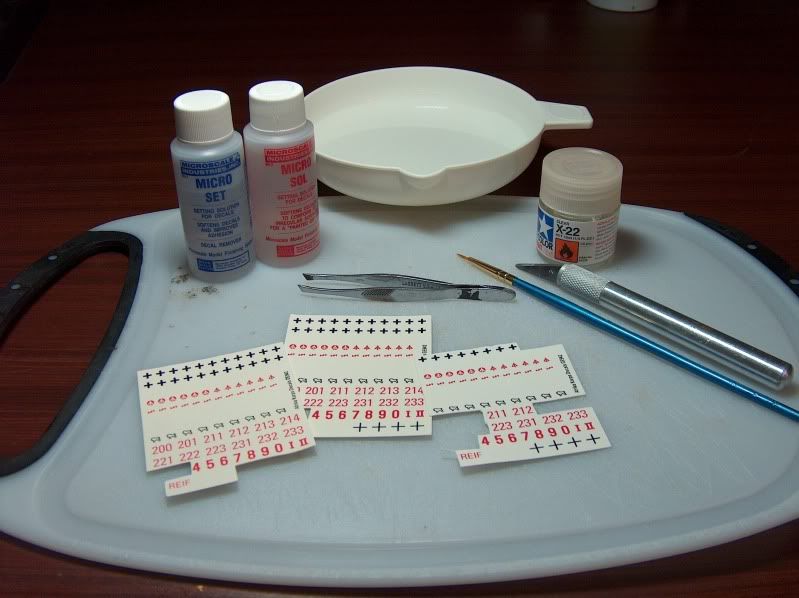
I always said I should do a full blown tutorial of how to do decals, and I figure this is as good a time as any.

First lets start with what you will need;
  • Micro Set
  • Micro Sol
  • Gloss Varnish
  • Pin
  • Hobby Knife
  • Fine Paint Brush
  • Tweezers
  • Warm Water
  • Decals
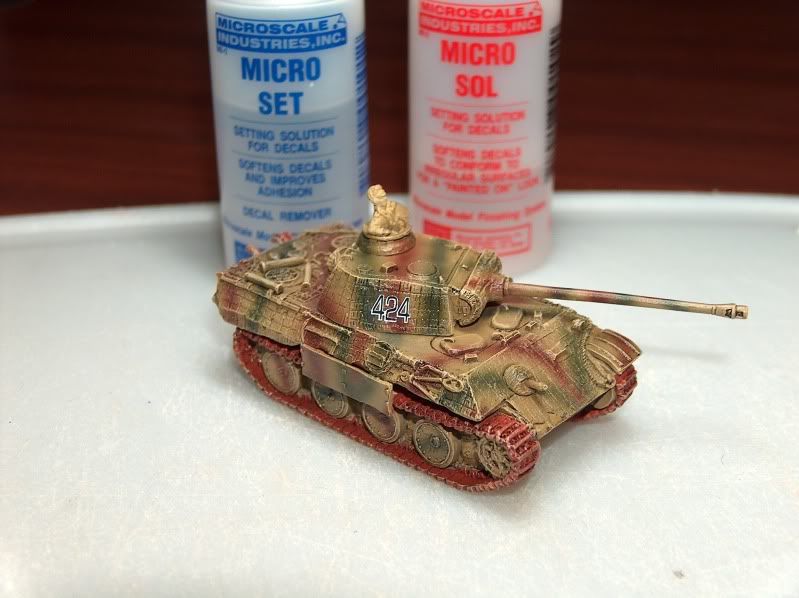
Yes you will need both Micro Set and Micro Sol.  I have never seen any one else use both.  I have tried just Micro Set, and I have tried just Micro Sol.  Each alone doesn't really work that well.  There is a reason they make both.  Especially if you are doing vehicles with Zimmerit.

Step 1
You will need to cut out your decals.  If you shine your decal sheet in the light you can see the edges of each decal.  Be careful not to cut your decal.

Although some times you can cut the edges so that the decal will fit better.  Its not so bad now but with the older decals, there was a lot of 'extra edge' to the decal.  You could really shave them down.  German crosses used to be a single square piece.  Now they are better and are more uniform to the cross.

When you are cutting your decal, make sure you leave them with some paper out side the edge of the decal.  You don't want to actually be grabbing the decal with your tweezers when it slides off.

Now plan where each decal will go and how it will fit.
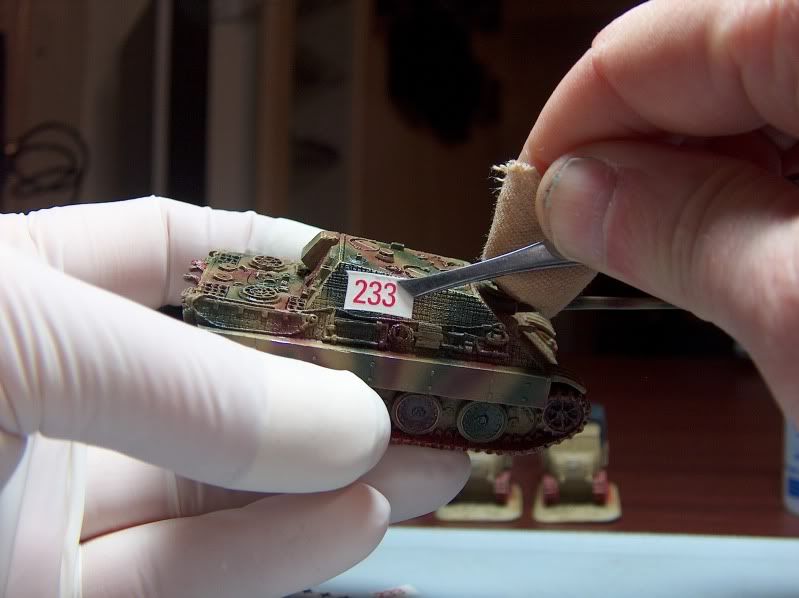


Step 2
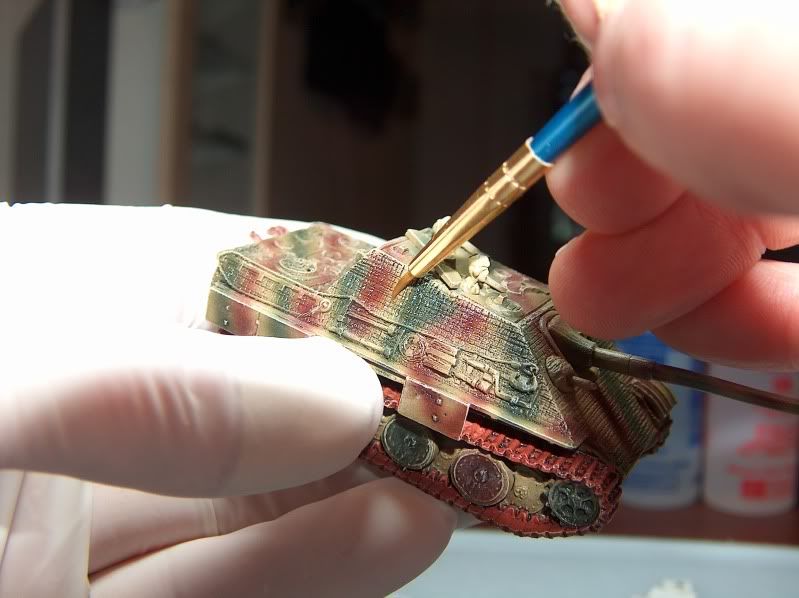
Brush the area you planned for your decals with a gloss varnish.  I use Tamiya X-22 Clear.  Make sure you have done a full gloss varnish, or at the very least a wash, over the whole vehicle before doing decals.  If you don't you'll find that the brush on varnish and Micro Set will rub off your paint.

Do a bunch of vehicles at the same time to give the varnish time to dry.  For this tutorial I did about 10 vehicles.  The first one was dry by the time I glossed all the decal spots.


Step 3
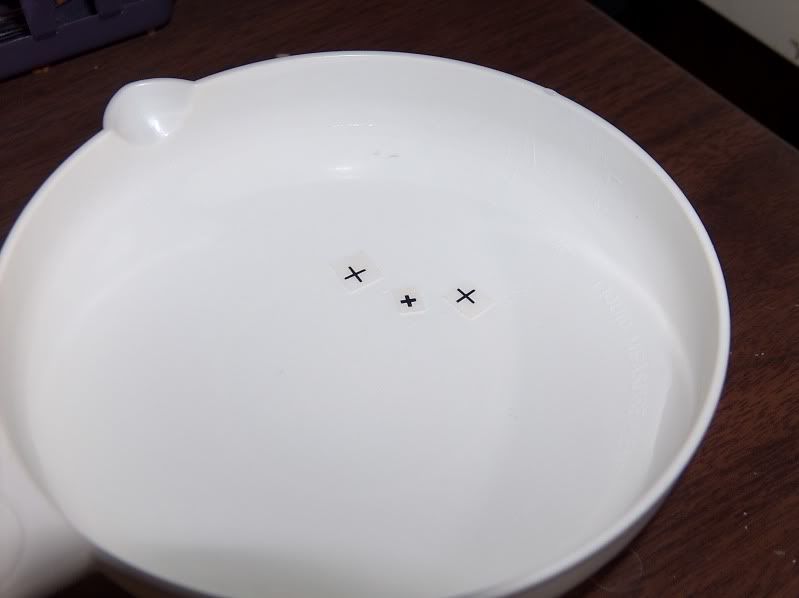
Now you want to put all the decals for one vehicle into your warm water.  Don't put to many decals in your water.  If they are in the water too long the decal will slide off the paper and you'll have a hell of a time trying to get it onto your vehicle.

And yes you for sure want to use warm water.  I find I change my water every couple of vehicles.  As soon as the water is no longer warm to the touch.  If the water is cold, you will wait forever for the decal to slide off the paper.


Step 4
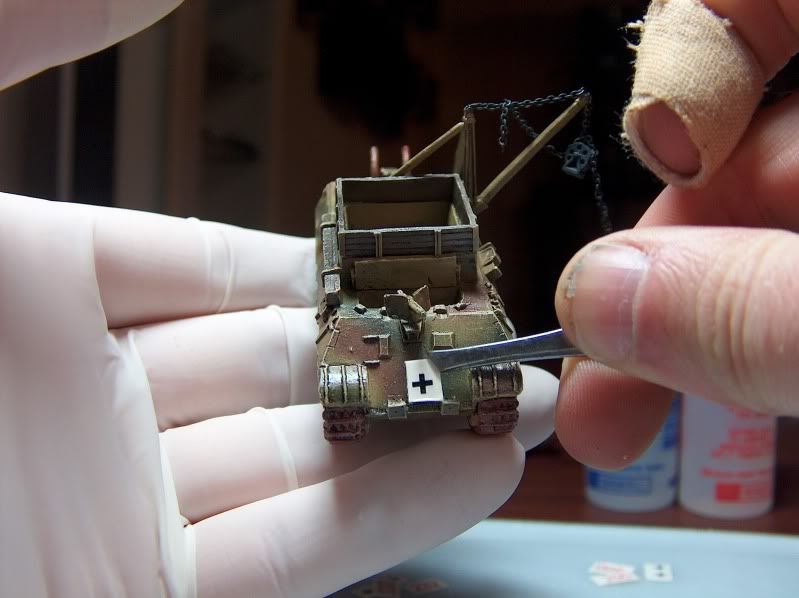
Use your fine brush to see if the decal will slide on the paper in the water.  If it does its ready.  To start this step I have my fine brush in one hand and my tweezers in the other.

Grab the decal with the paper being careful not to grab the decal.  Keep your decal parallel to surface of the water as you lift it out.  If its been in the water to long and you lift it out perpendicular to the water surface the decal will slide right off.

Once you have a hold of the decal and its out of the water, touch the bottom of it to some paper towel.  This will suck some of the excess water from the decal.


Step 5
This is where you will need Micro Set.  Make sure you don't mix up using Micro Set and Micro Sol, it will make a difference.

Dip your brush into the Micro Set.  I usually pour some into the cap.

I try to put something under one side of the vehicle so i can easily slide the decal into position


Using the brush, slide the decal onto the vehicle.  It doesn't matter if it goes on straight.  Just as long as it goes on to the spot where you brushed the gloss varnish on.

Dip your brush back into the Micro Set.  With the brush position the decal where you want it.  At the same time make sure you brush the entire decal with Micro Set.

What Micro Set does is make the decals glue more adhesive.

Step 6
Using a Q-Tip gentle press the decal against the surface of the vehicle.  Be careful, the decal could still slide around.  The Q-tip will soak up any excess water and Micro Set, so that the decal will stick to the vehicle.
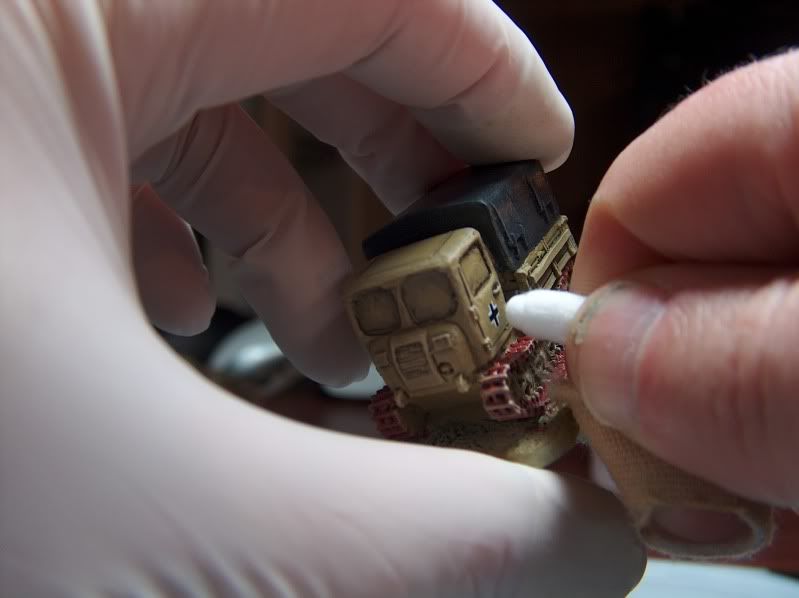


Step 7
Now, repeat steps 4-6 for the other decals on the same vehicle.
And then repeat steps 4-7 for the rest of the vehicles you are doing.

Step 8
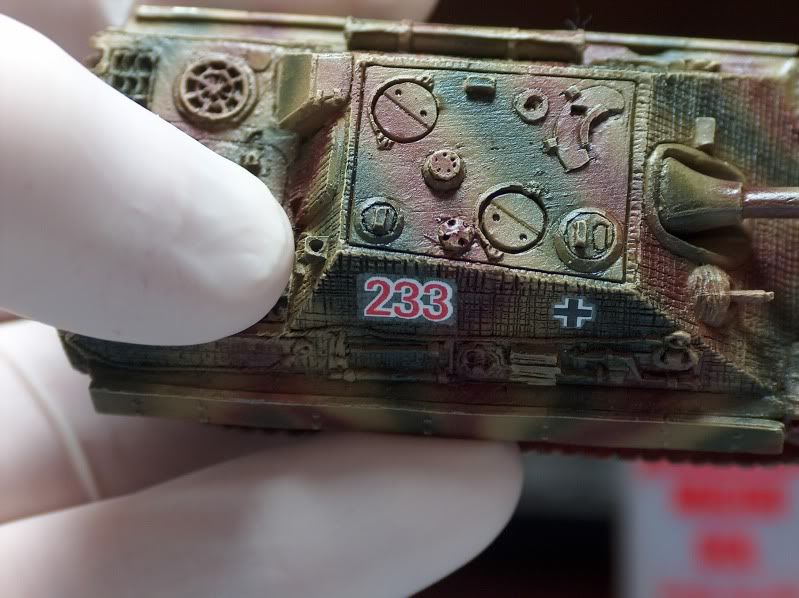
Going back to your first vehicle, check the decals for silvering.  Its ok if they do.  Most likely at this point your decal will only silver if placing it on zimmerit or on an odd surface.  This is the case when putting a 3 digit number on say a panzer III turret.  There isn't a big enough flat surface for the whole decal.
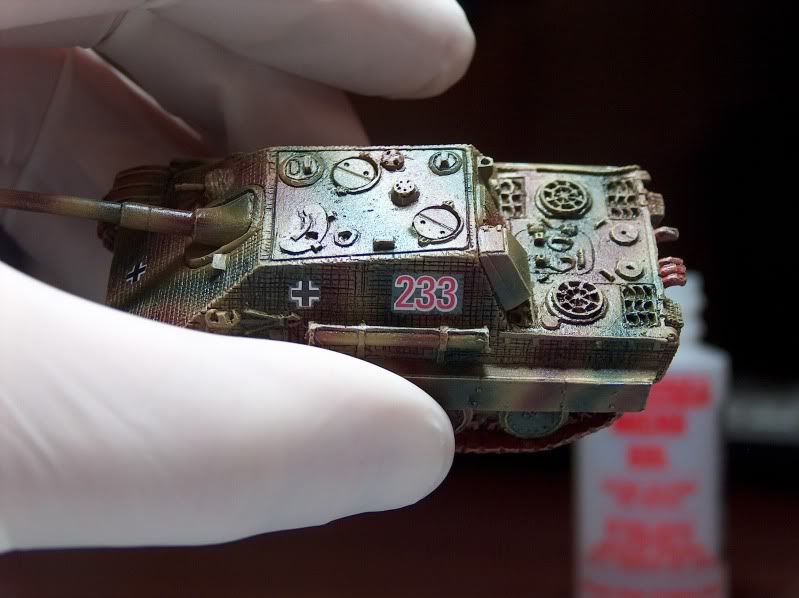


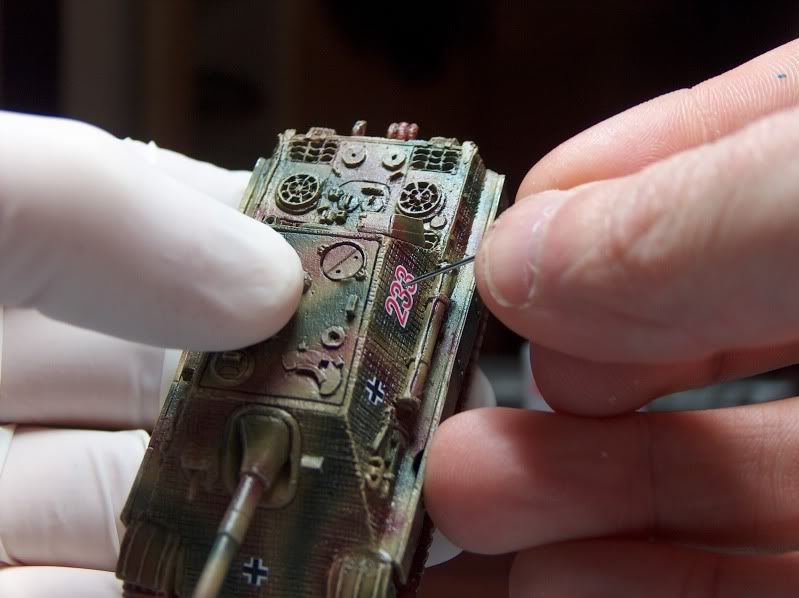
If you do find some silvering, take you pin and gently poke a hole in your decal.  I like to poke around and in between the numbers.  I don't usually poke the actually "paint" of the decal unless its black.  Be very very careful when doing this.  You can wreck your paint if you poke to hard.

Zimmerit is great for this because you can poke into the zimmerit.


Step 9
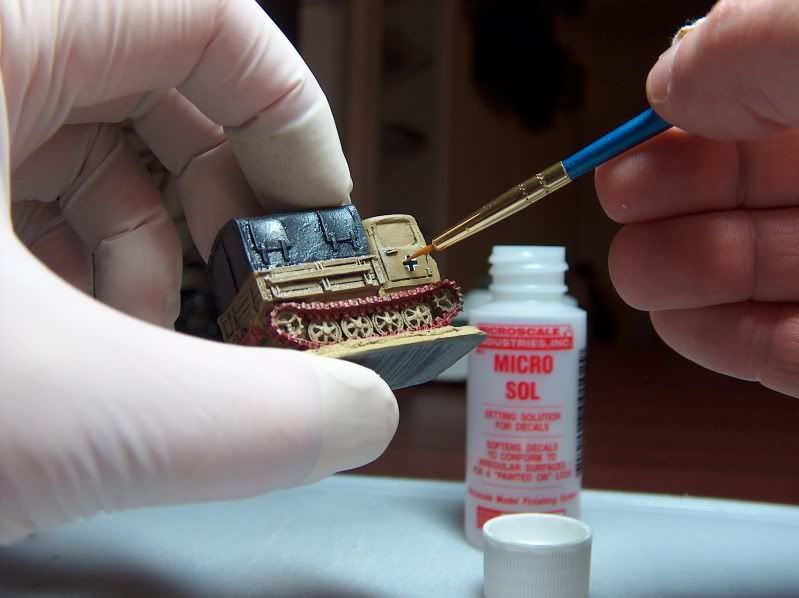
Now, take your Micro Sol and brush it into your decal.  Even if your decal had no silvering and you didn't need to poke your holes, I will still brush it on the decal.

If it did have silvering you should see the decal soak it up.

What Micro Sol does is make your decal soft so it will conform to irregular surfaces.  It doesn't matter if its zimmerit or uneven resin. 
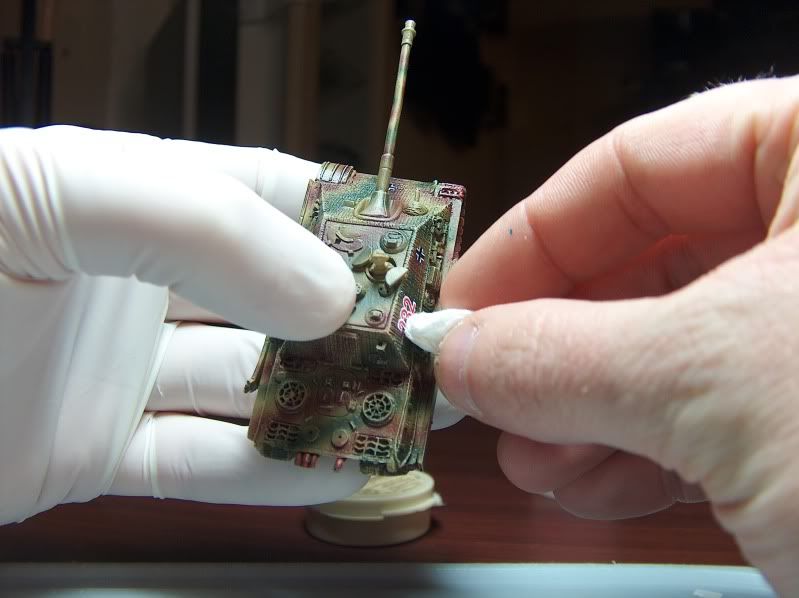


Take a small piece of paper towel and gently press the decal into the surface of the vehicle.  You can't use the q-tip for this because Micro Sol makes the decal sticky.  You'll find little fibers from the q-tip will stick  to your decal.

As you press, you can see the decal conform to the surface.  I'm still amazed how well this works.


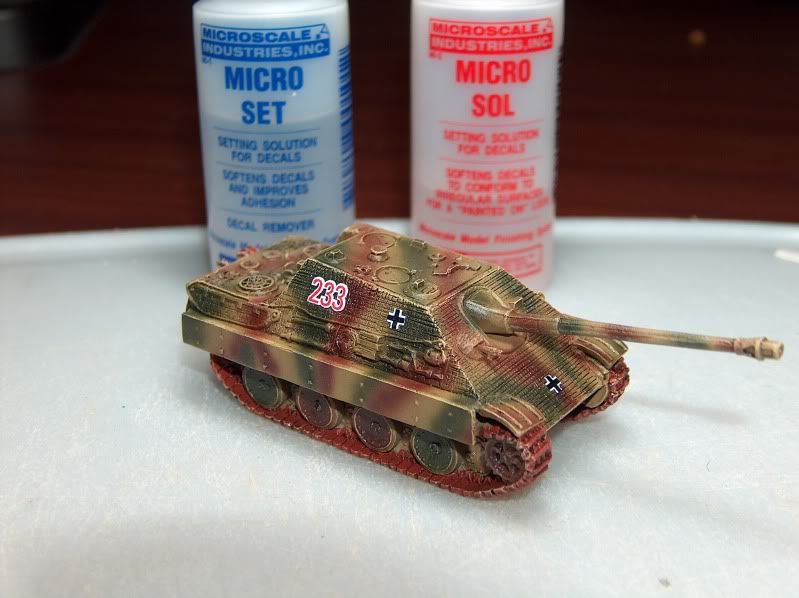
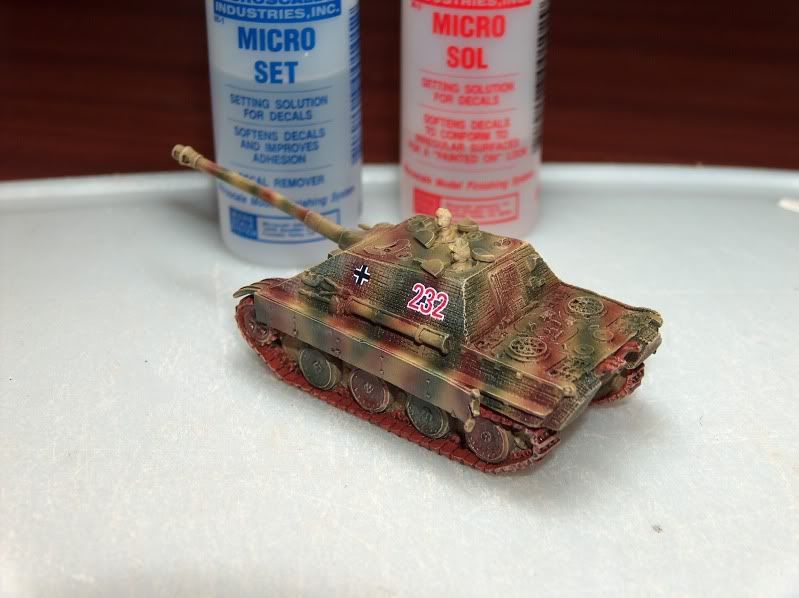
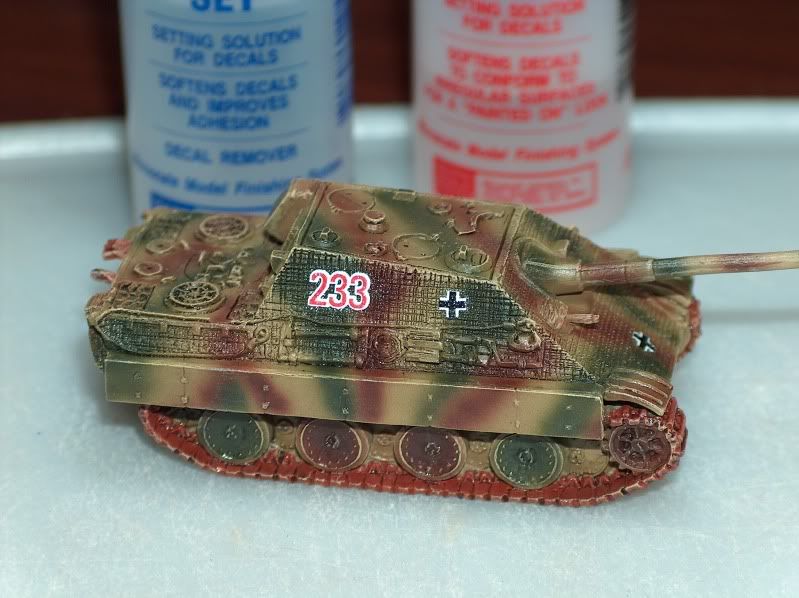
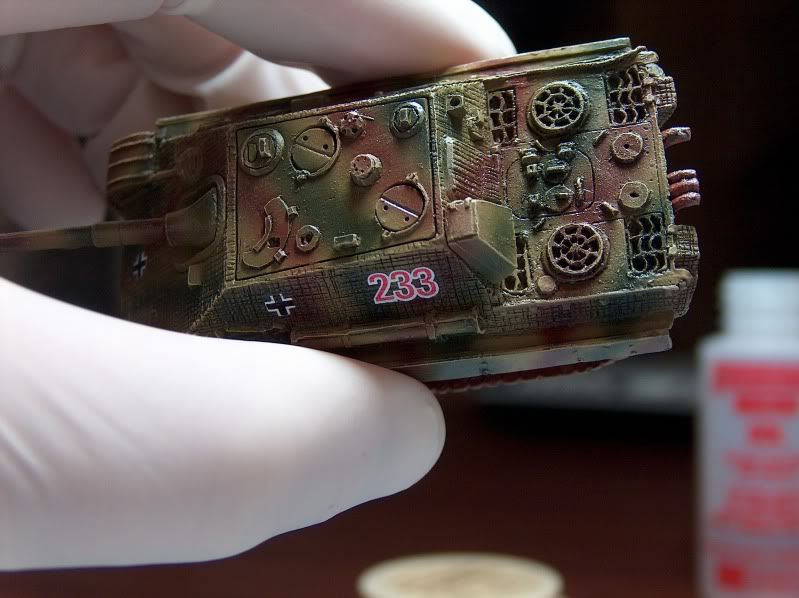
You can see in the pics below there is no more silvering. 

Step 10
Go back and repeat steps 8-9 for the rest of your vehicles.

Completion
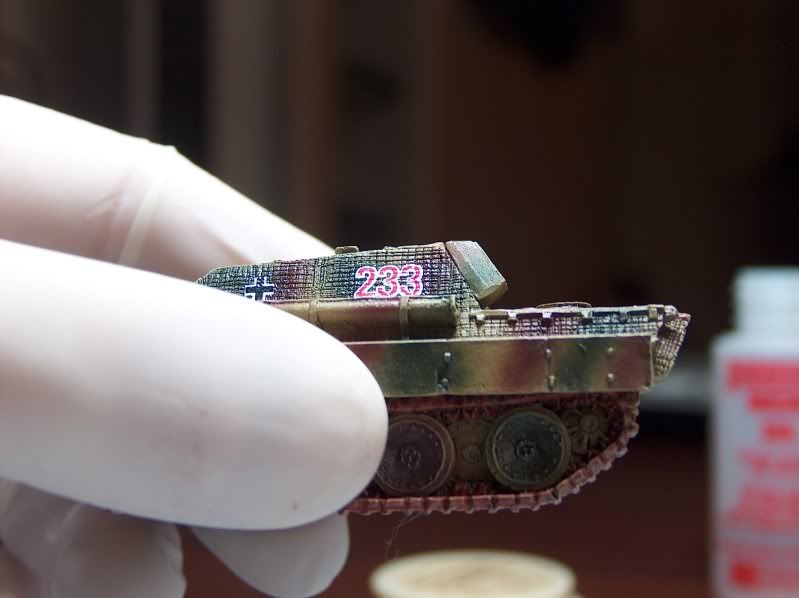
There you now have perfect decals even on zimmerit.

Don't worry if your decals are still shinny and you can see the edges.  This will disappear when you do a matt varnish.  I even spray a little extra where the decals are.

Some people like to do a gloss varnish after they are done the decal.  I don't do this.  I don't see a point.  My matt varnish will seal them.

You may notice I also do my wash and highlight before I do decals.  I think a lot of people do this after decals.  I find some decals are thicker then others.  Mostly the older Soviet stars.  And the decal edges will get picked up by the highlight and wash.

You can still do weathering to dirty up the decals.  So, no need to do a wash and highlight after the decal.  Safer to just do it before.

There you go.  Hopefully this will help some people do better decals.  The key is using both Micro Sol, and Micro Set.

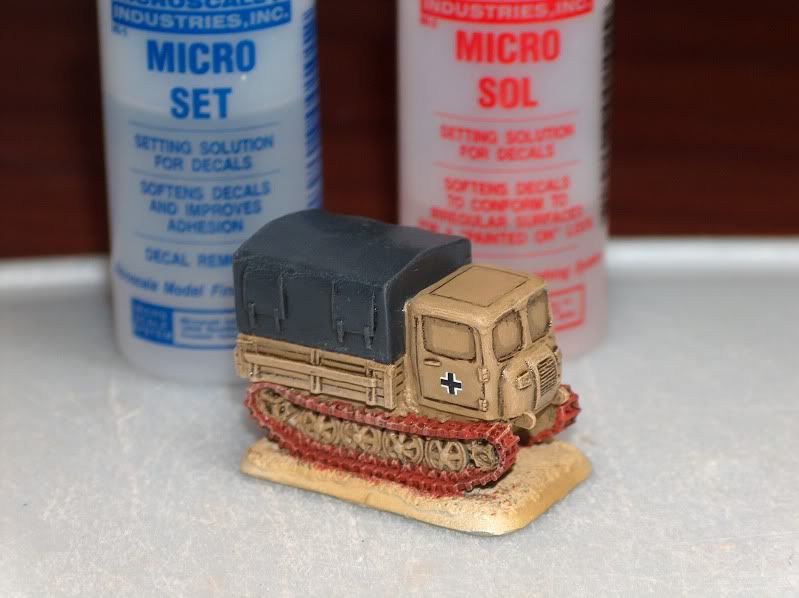
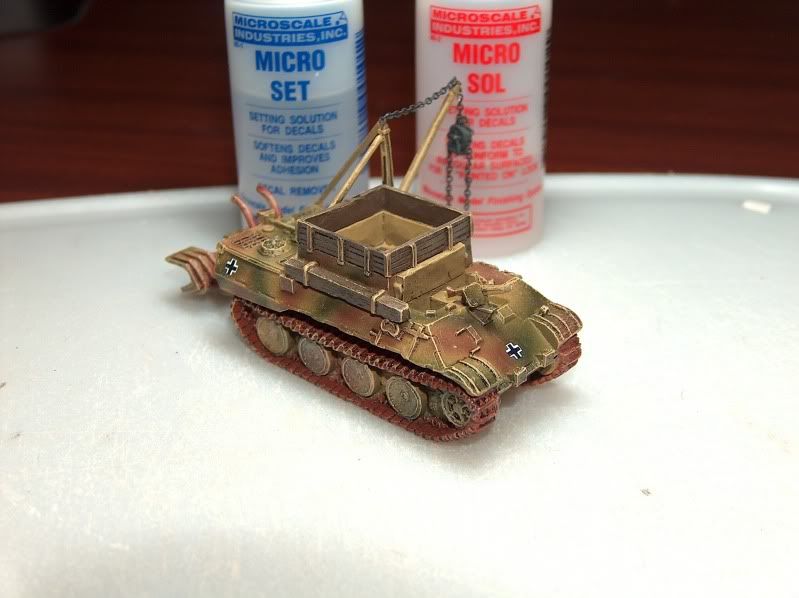
Here are the rest of the vehicles for this project.  Not a single bit of silvering, and all conform to the zimmerit.
Sunday, April 3, 2011

Schwere PanzerJagerKompanie Part V - Wash & Highlight

In case you missed some:
Schwere PanzerJagerKompanie Part I - Intro
Schwere PanzerJagerKompanie Part II - Preperation
Schwere PanzerJagerKompanie Part III - Airbrushing
Schwere PanzerJagerKompanie Part IV - Detailing

Doing a wash seems to be the most popular but most obscure technique in all of painting miniatures.  Its so hard to find an exact formula of what a wash actually is.  It always "some" of this, or a "few drops" of this.  Never an exact formula.  And if I did ever find an exact formula I couldn't get it to work. 

The closest I found to the "Magic Wash" formula was 1 part future, 4 parts water, and "a few drops of your favorite pigment".  A few could be anything from 2 to 7.  In testing wash formulas I've found 1 drop makes a huge difference in how dark your wash is.  Just saying "a few"  doesn't cut it.
I always use an excel spreadsheet to keep track of EXACT formulas for anything I do in painting.  On this little project I'm actually finding there needs to be different formula for different jobs.  I also tried something new.  I did a pre-mix of future and water.  Usually I just did straight Future.  I tried the 1:4 future to water, but found it was to watery.  So, I tried 1:1.  This is now my "Magic Wash".

To get my "parts" I use droppers.  I use this when airbrushing as well, to mix my 3:2 paint to windex formula. 

For a black wash I use games workshop black ink.  I tried to Vallego black shade, but found it wasn't dark enough for what I like.  For tanks I used a 1:20 mix of ink to magic wash.  For infantry I used a mix of 1:40.  I also tried giving 2 coats of wash.  I never wanted to try this before because I figured it would make things too dark.  It seemed to work really well.

For flesh I use about a 1:2 or 1:3 W&N peat brown to magic wash.

If anyone else would like to share some EXACT wash formulas I'd be super interested.


After all the wash, I do a dry-brush highlight of everything.  Usually a 3:2 base coat to white.  I keep finding I have to do it lighter highlight then I would think, because my matte varnish really lightens things up, and the highlight disappears there isn't enough contrast between the base coat.  

Up next will be my decal tutorial.
Sunday, March 27, 2011

Schwere PanzerJagerKompanie Part IV - Detailing

In case you missed some:
Schwere PanzerJagerKompanie Part I - Intro
Schwere PanzerJagerKompanie Part II - Preperation
Schwere PanzerJagerKompanie Part III - Airbrushing

Well, I'm not sure how much I would call this detailing.  Not for the tanks anyway.  I basically paint everything that needs to be painted before a wash.

One thing that could possibly be the best thing to advance my painting besides the airbrush, is a wet palette.  I can't believe how many years I went without one of these.  It saves so much paint.  I always found, especially with brown and flesh colours that they dried up so fast.  Dried acrylic paint is amazingly hard to clean from a plastic palette.  The wet palette is just amazing.  Its super cheap for how much time and paint it saves.  I would suggest it to anyone.  Its basically a piece of paper over a wet sponge.  I can leave a spot of paint over night or even a few days, and still be able to use it.  I cannot stress enough for new painters (and experienced ones) to get a wet palette.

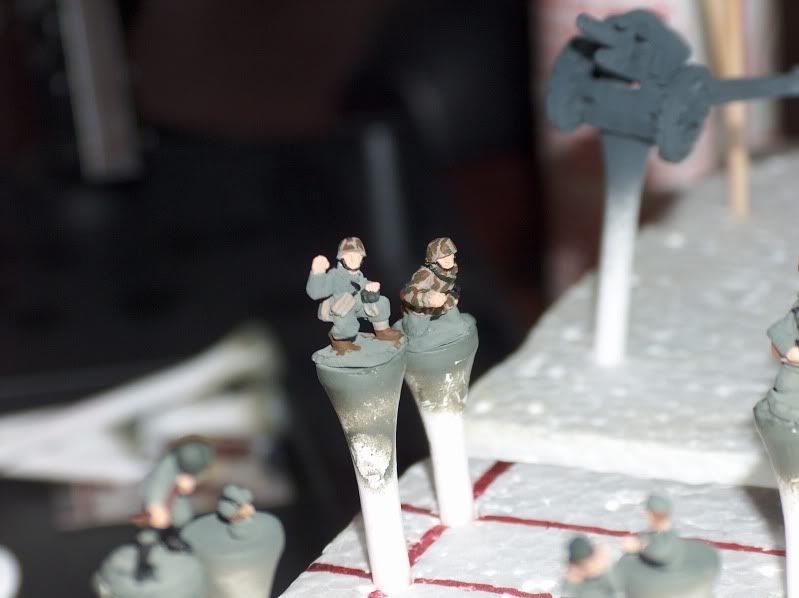
The artillery crew, I paint everything.  Belts, pouches, guns, everything.  Recently I've had a problem with what colours to paint this stuff.  Especially for the Germans.  I have 3 or 4 different guides for painting Germans and rarely do they say the same thing.  The helmets are a great example.  We've all seen WWII movies, and German helmets ALWAYS look dark grey.  BF's mid war guide says German grey, and BF's late war says German Camo Green or middlestone.  I've never seen a green German helmet except for DAK forces.  In doing some research it would seem that German helmets varied in colour as much as the soldiers themselves.  I found that no 2 helmets ever looked the same colour side by side.  So there is probably no right or wrong answer.

Another issue, is pouches.  Most guides say Green Grey.  Well this is insanely close to Field Grey, and hard to even tell apart using the 3 Foot rule.  But its all trial and error to find out what looks good and is still historical.

The last thing I do, once infantry detailing is done, is to go back over each guy.  Mistakes will be made.  Its usually flesh colour on the uniform base coat.  So, I just quickly check things over and cover up any mistakes.

Tanks I don't do any details.  I do a pretty heavy drybrush after the wash, and it ruins any details you might paint, like tool handles.  So there is no point.

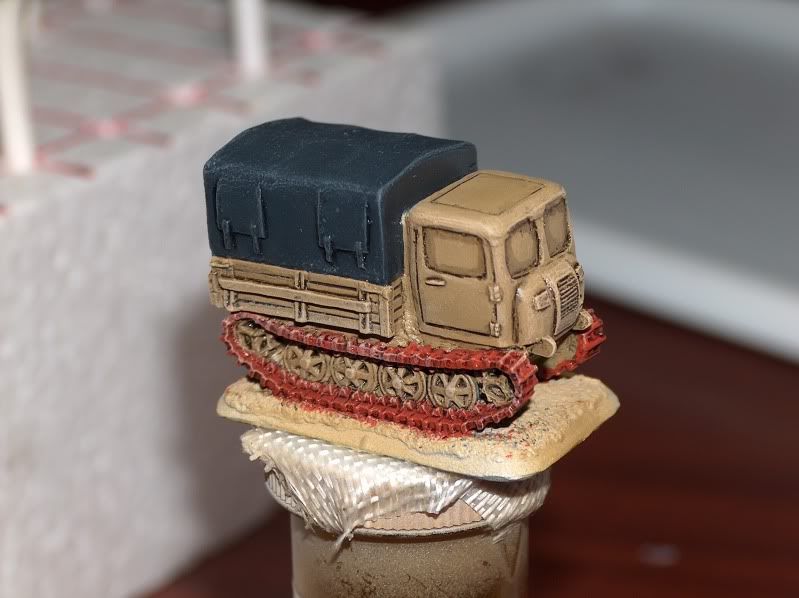
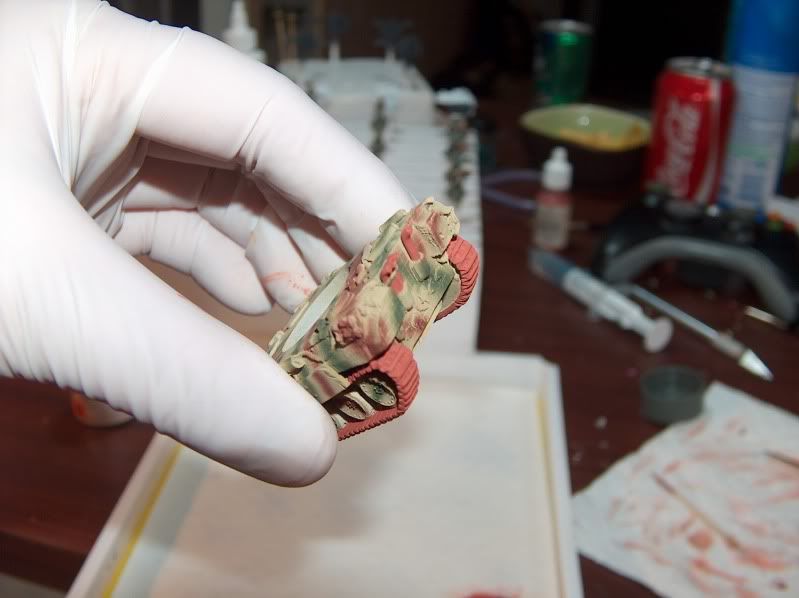
What I do paint is the tracks and exhaust a rust colour.  And like with the RSO's I also paint the tarp.  Everything else is left until after the wash and highlight.

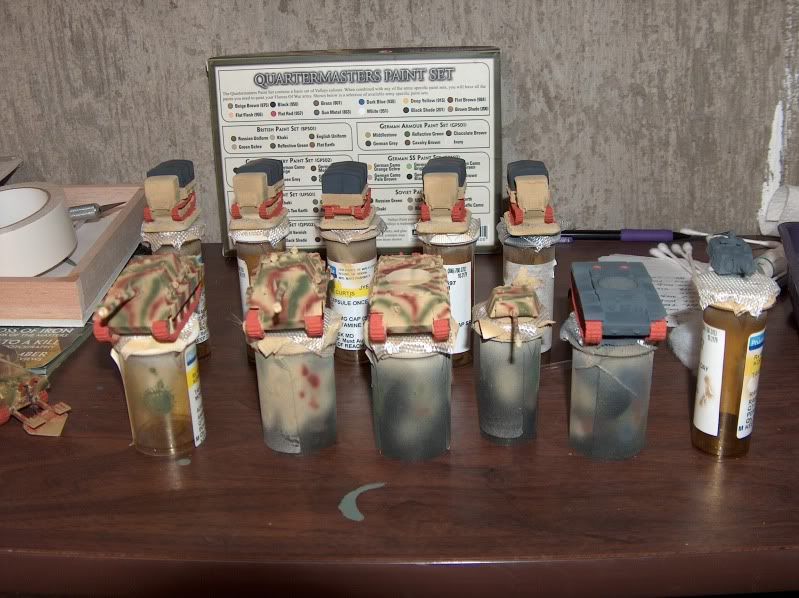
Then everything gets mounted (ha ha...I said mounted) back on the prescription bottles and ready for a layer of Gloss Varnish.

I'm thinking of doing a gloss varnish on the artillery crew.  I've never done this before a wash with infantry before.  But I'm hearing more and more the gloss varnish helps a wash flow...I'm still thinking about it.


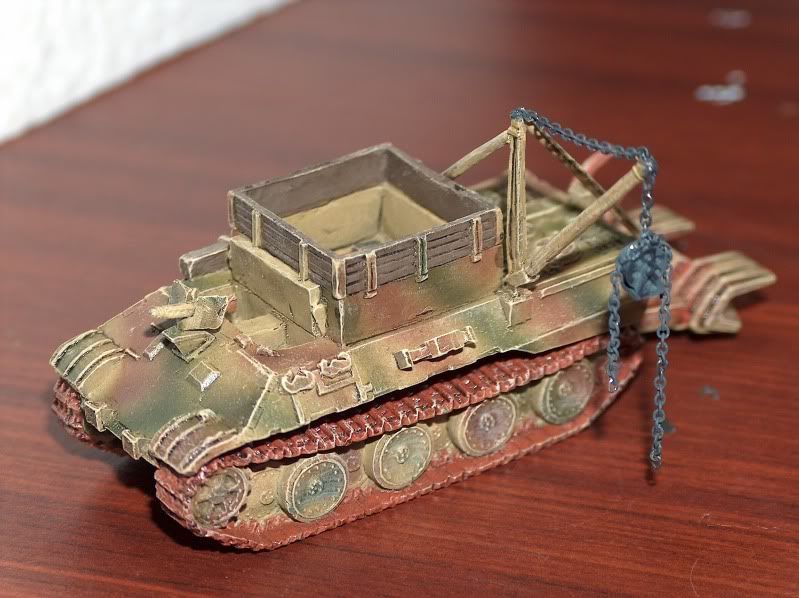
And a little teaser to the BergePanther. Added a chain and pulley.

Monday, March 21, 2011

Schwere PanzerJagerKompanie Part III - Airbrushing

In case you missed some:
Schwere PanzerJagerKompanie Part I - Intro
Schwere PanzerJagerKompanie Part II - Preperation

And now its time to do the airbrushing.  I'll do all the airbrushing for the entire company.
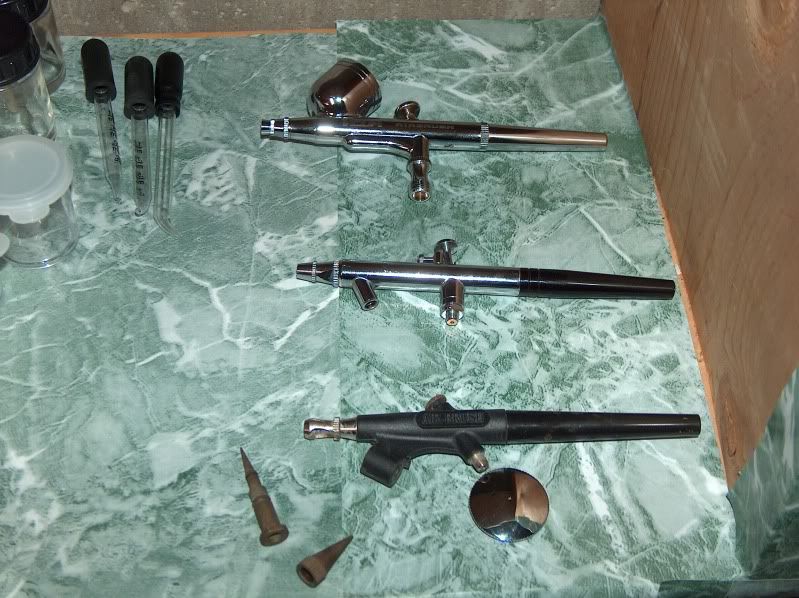
I use 3 kinds of airbrushes.  I use a single action for all the priming and base coating of vehicles.  I use a double action 3.5mm suction for infantry.  And I use a double action 3.0mm gravity fed for camo patterns.  I do have a 2.0mm airbrush, but really haven't broken it out yet.  the 3.0mm seems to be good enough.   

For all the noobs out there.  If you can get gravity fed airbrushes do it.  I love these things.  They use way less paint, way less maintenance, and they just spray perfect every time.  The suction ones are always just so much work, and they seem to work different all the time.

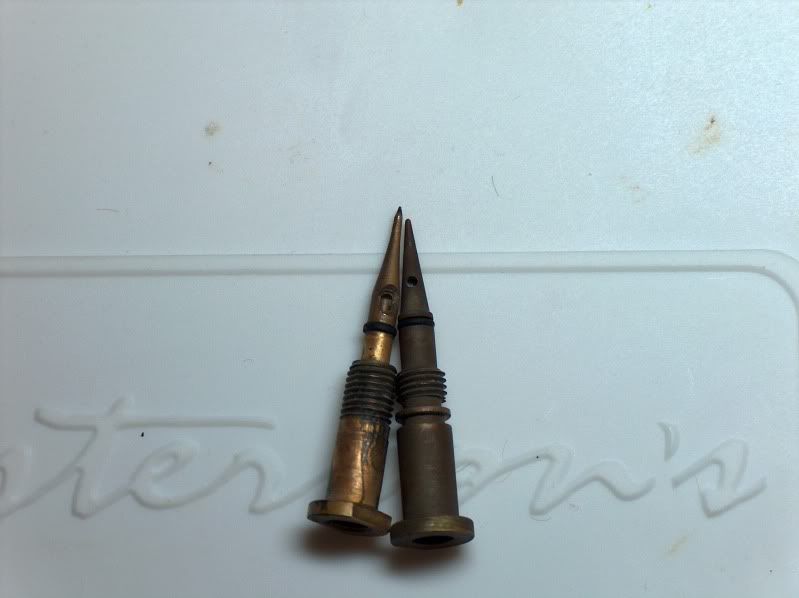
The single action ones especially you have to be careful.  Maybe this is common knowledge, but I certainly didn't know.  I thought all these single action airbrushes were the same.  Apparently they aren't.  I bought 2 of them, 2 different brands, but seemingly exactly the same.  The packages certainly didn't mention anything different about something very important say...oh I don't know....the nozzle.

I was using these 2 single action airbrushes in conjunction so that I wouldn't have to spray, clean, spray, clean.  I thought I could spray 2 different colors and then clean both.  One of the airbrushes I could almost never get to work.  And if it did work, it went through paint like it was going out of style.  Then for some reason I happen to see the nozzles side by side.  Well HOLY SHIT.  Look at the size difference in the nozzle.  No wonder that stupid thing sucked.  No pun intended.  Needless to say I've stopped using that airbrush.

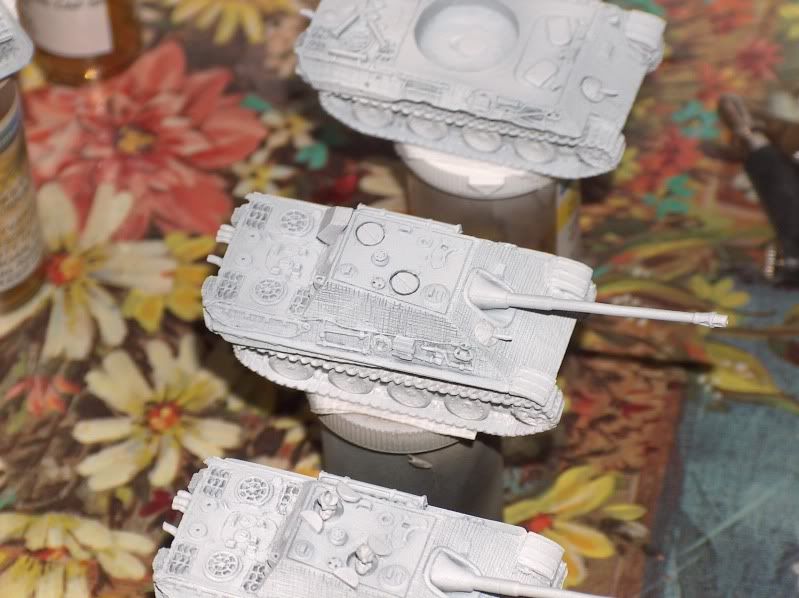
Anyway, on to the work.  Because I'm always trying to improve, I'm always trying new things.  So, who knows how this stuff will turn out.  First thing I did on this project was to prime the vehicles, using the single action airbrush.  This is a first for me, I primed them white.  Normally I'll prime black, or just do 2 base coats.  I wanted to see how it would work.  The problem being, if anyone actually reads this stuff, I mix Windex with my paint for airbrushing.  This turns your white paint blue.  So, I had to use thinner, which I find usually makes your paint too watery.  I used about a 3:1 mixture and it seemed to work pretty good.  Once that is done I will clean up the brush and let the nozzle sit in some Simple Green.

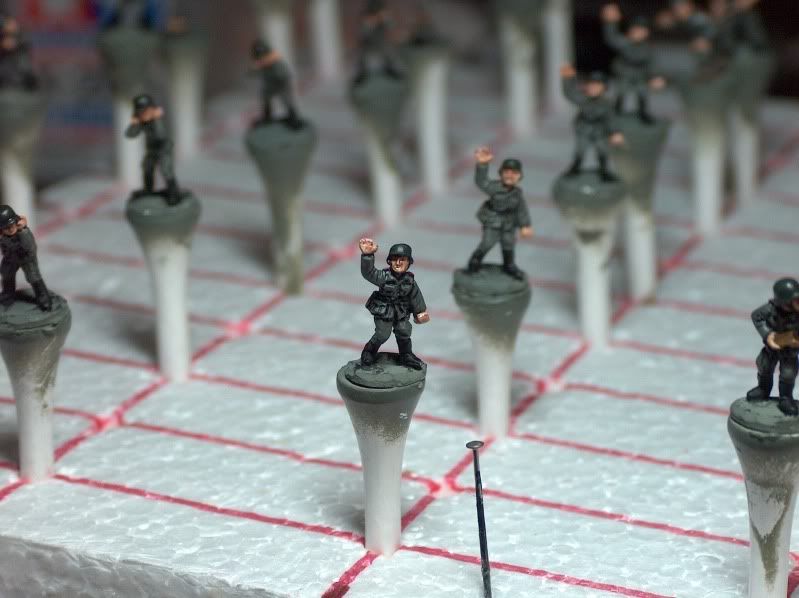
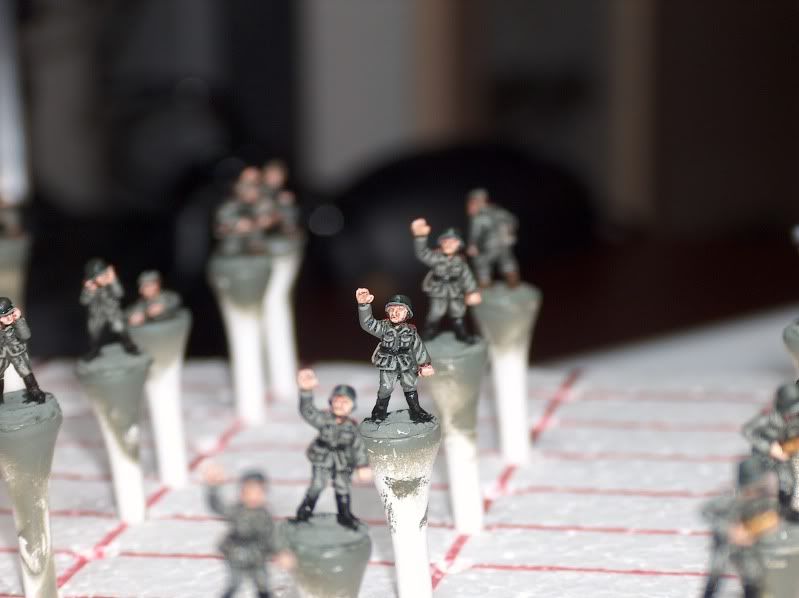
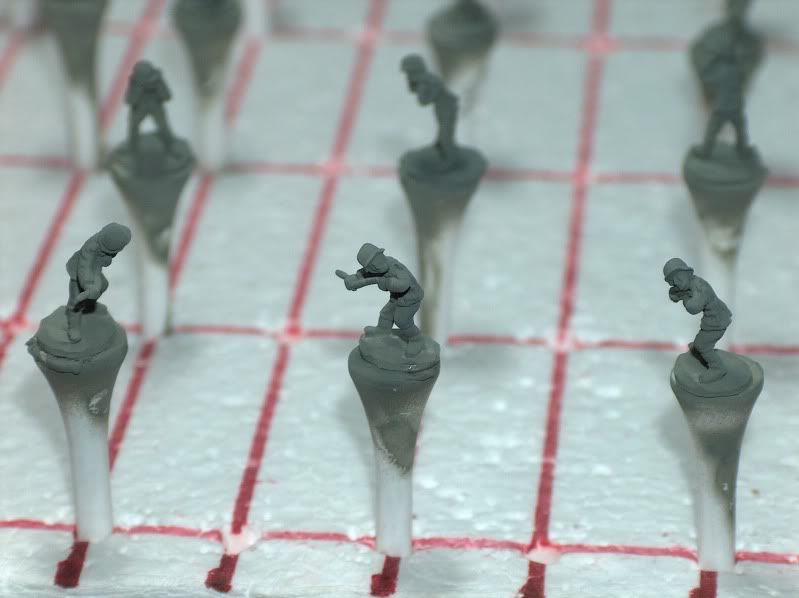
Moving on to the infantry, I use the 3.5mm to prime and base coat them.  I don't really prime them though, I just do 2 or 3 coats of base coat.  I pretty much exclusively use Tamiya in my airbrush, and I don't find colors are brighter or darker just because of the base coat color.  For Germany uniforms I use XF-22, RLM Grey.  I mix 3 parts paint with 2 parts Windex.

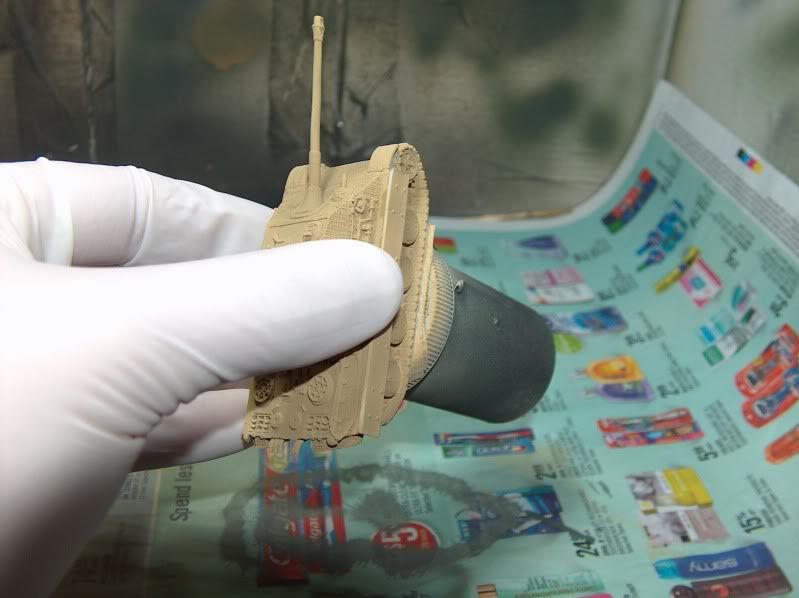
Lets see whats next?  Oh yes, I go back and clean the single action brush that has been sitting in the simple green.  Then I get ready to base coat the Tanks and RSO tractors.  I use XF-60, Dark Yellow for German late war vehicles.  Again I mix it about 3:2 with windex.  Oh ya I almost forgot to paint the Schurzen as well.

I once again I stick the single action nozzle in simple green and let it soak for a bit.

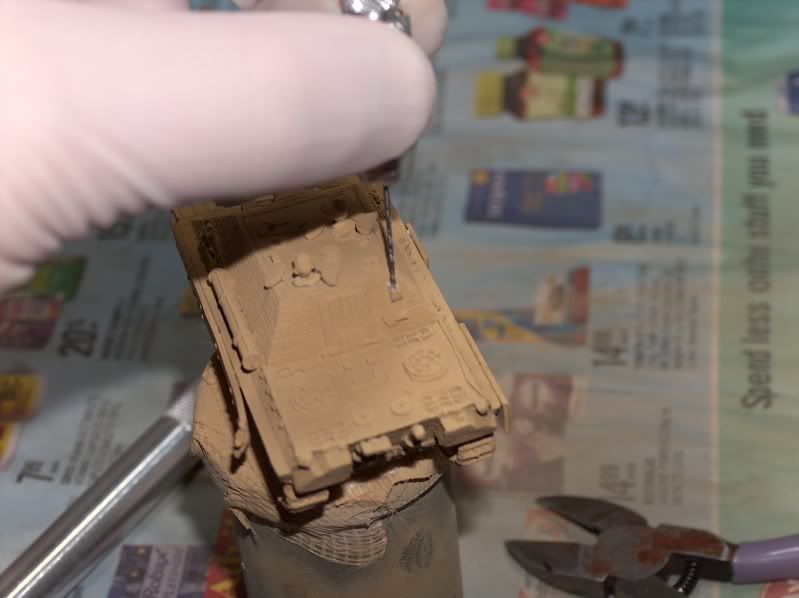
At this point I forgot about the antenna.  So I quickly drilled out the holes where the antenna will go.  I find if the hole isn't deep enough, the antenna will easily snap off if you accidentally touch it during game play.  So, I drill that hole nice and deep.  Ha ha...I said deep!  Inside joke for those that know me.

Tamiya paint dries very quickly so, I now take this opportunity to glue the Schurzen on.  I try to wear gloves when ever I'm going to be touching painted parts.  These jagdpanthers may have actually given me a revaluation with the panther shurzen.  I wonder if I've been putting them on upside down?  They have these tabs that look like you would glue them under the hull. The problem is on the jagdpanther they don't fit.  If you put them on the same as a regular panther they end up crooked.  the jagdpanther actually has this lip they fit on, but the only way they fit is if you cut these tabs off....or put them on upside down.  They fit great upside down and the tabs sit right on the track.  When I put my panther A's together, I may have to see if they fit that way as well.


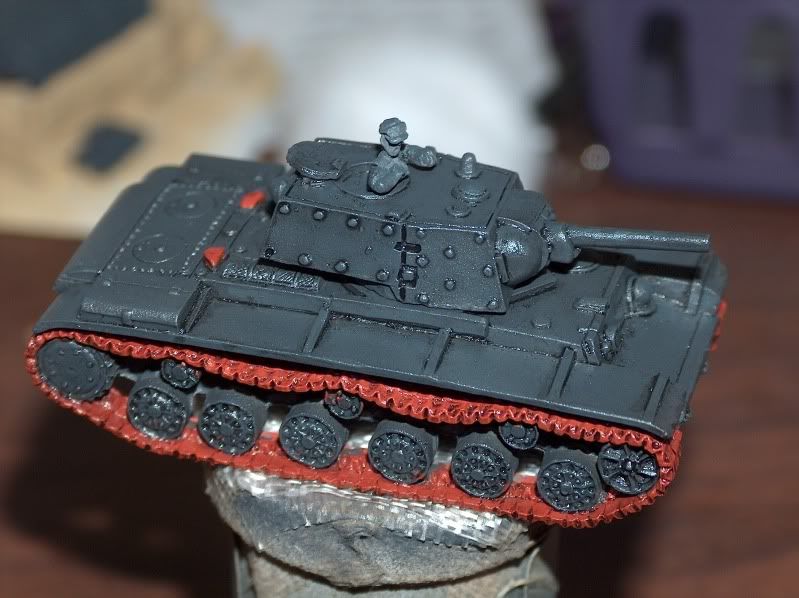
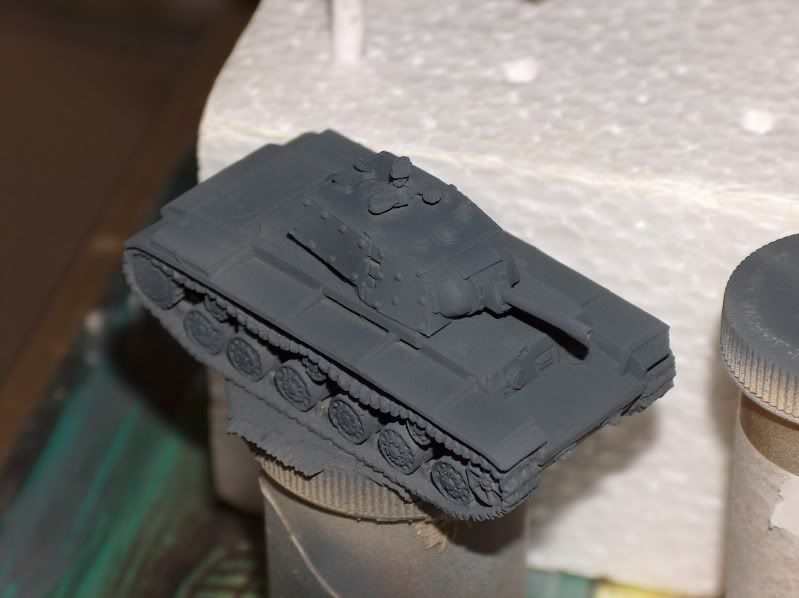
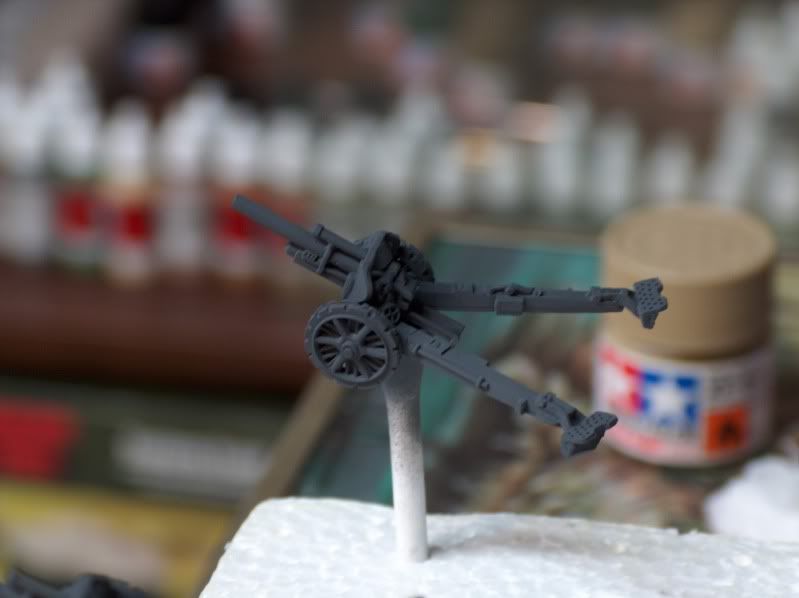
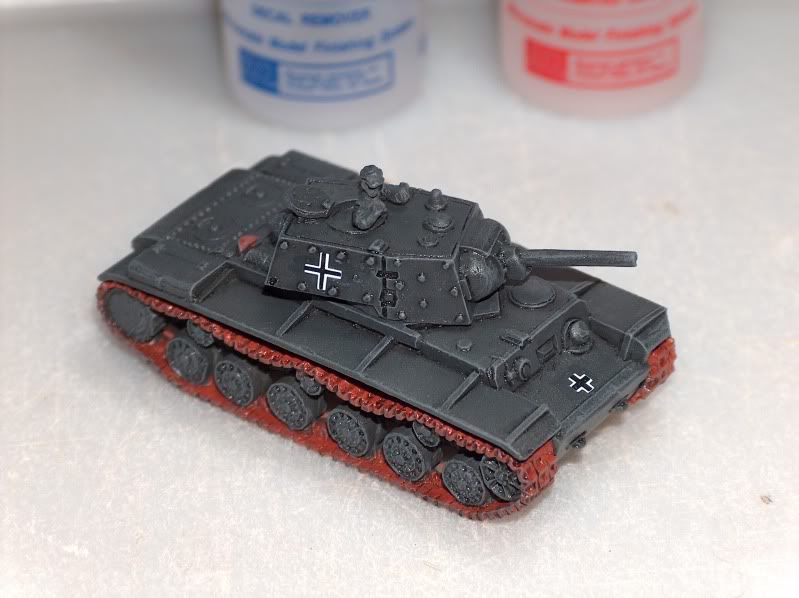
While the glue dries, I will paint up my 10.5cm guns.  I'm using XF-63, German Grey for these.  Even though this is for late war I want these guns to be mid war.  This is an older gun set, so If I ever decide to paint a late war gun set, I'll get the newer molds.  I also had a KV-1e captured tank I wanted to paint.  I had done it in dark yellow, but upon doing more research most captured KV's were German Grey.


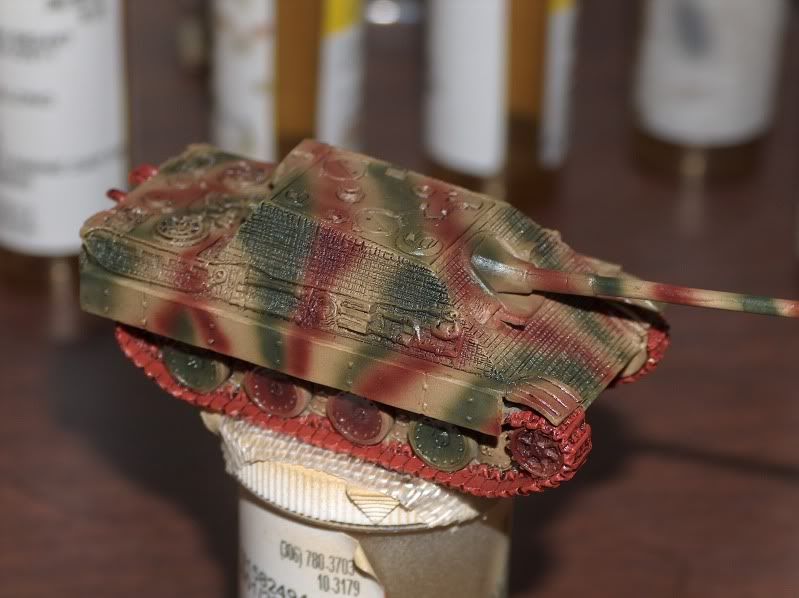
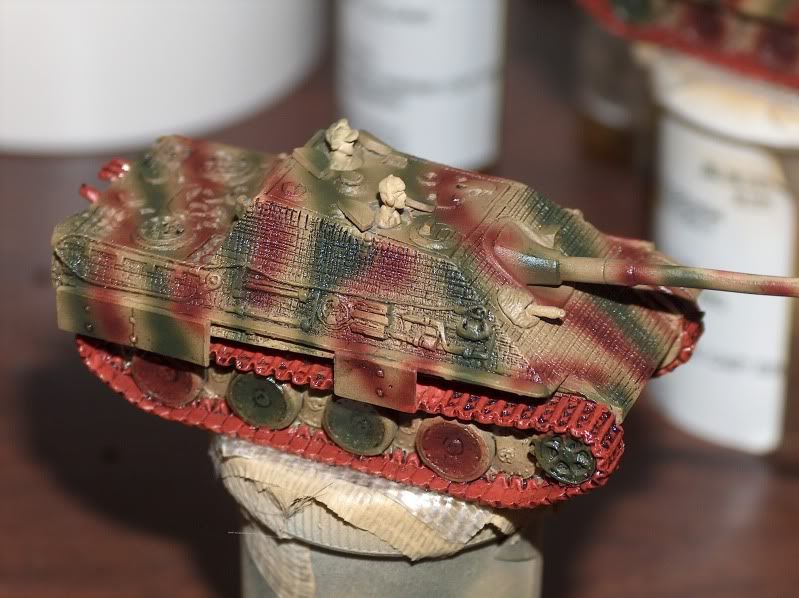
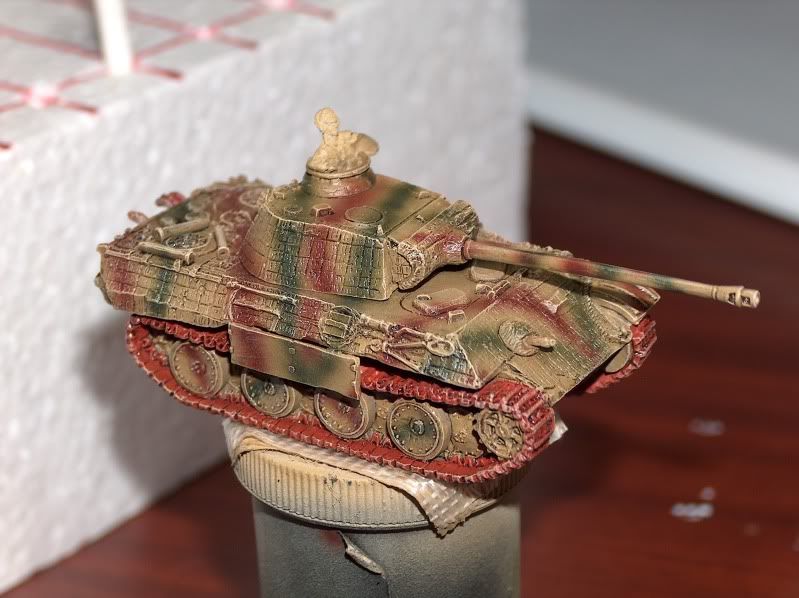
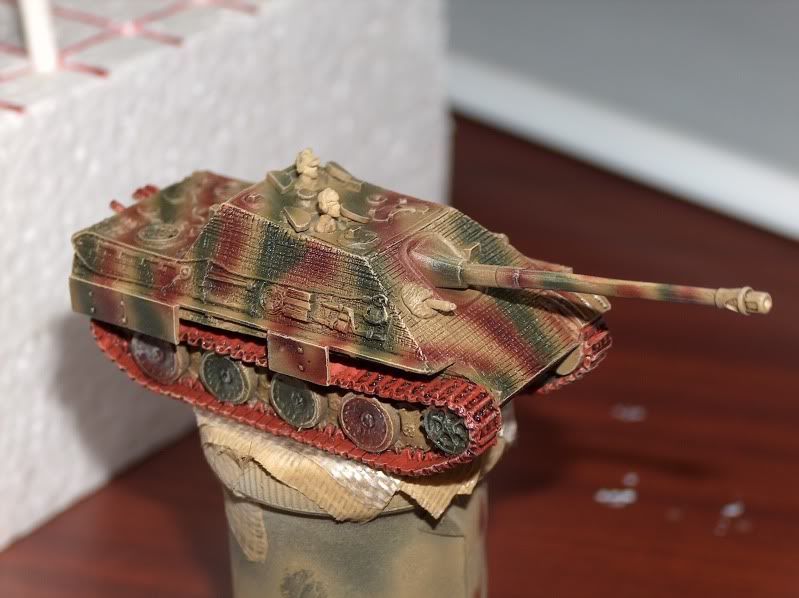
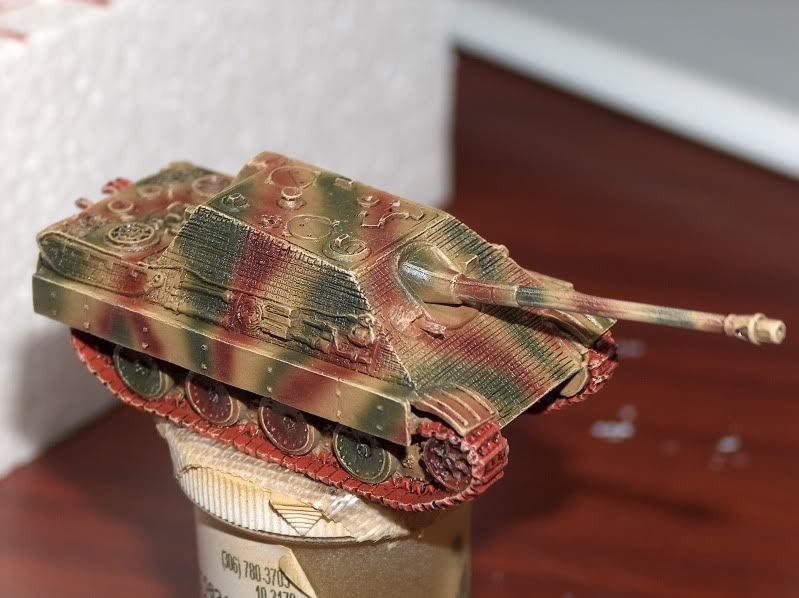
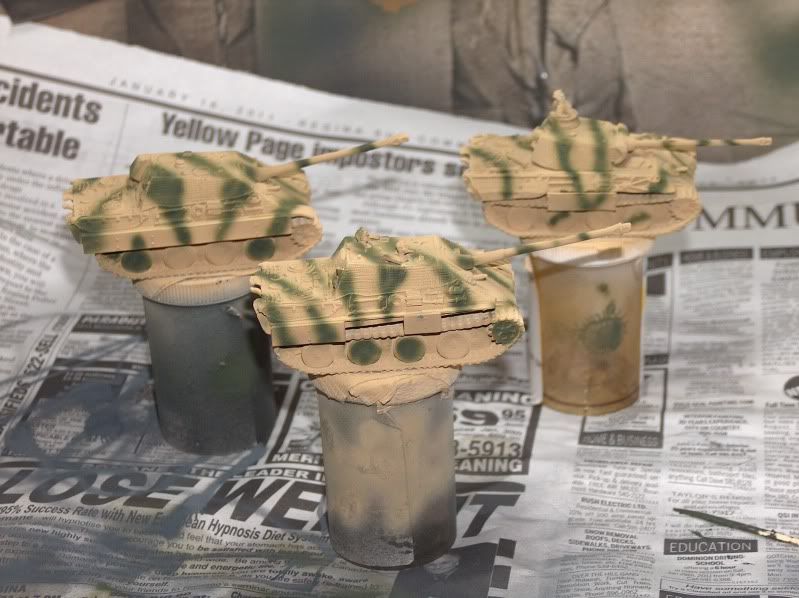
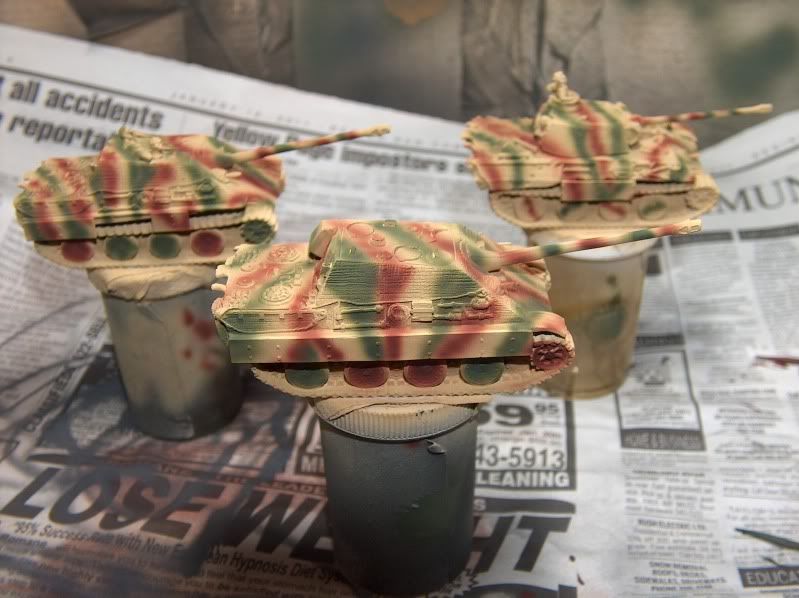
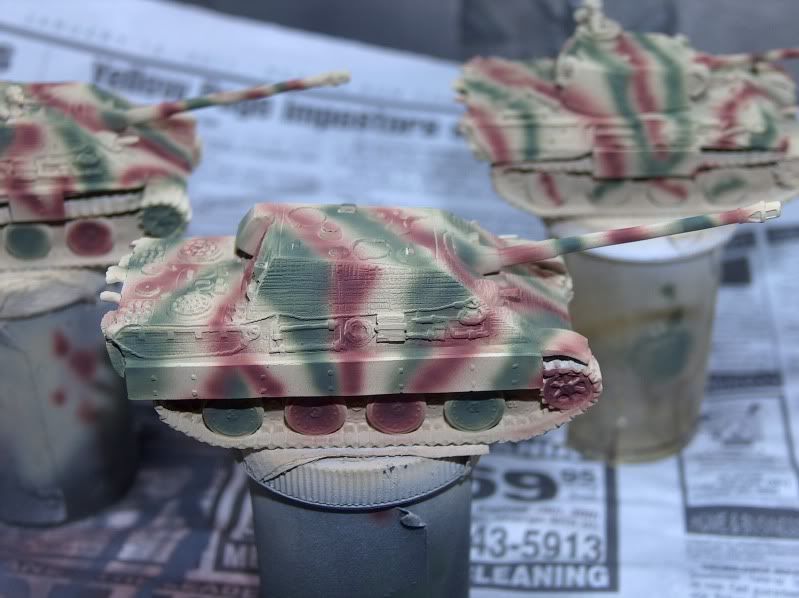
With the guns done, the schurzen should be dry, we can move on to adding the camouflage to the jagdpanthers and Noaks Panther.  For this I will use XF-58, Olive Green and XF-9 Hull Red.  Normally, like with my Konigstigers, I used XF-64 Red Brown, but I wanted to try this Hull Red.

I found some very good pictures of camo patterns for Jagdpanthers.  A lot of them for the time period had shown wheels painted in full colors.  So, thats how I did the jagdpanthers.  I kinda like it.  Normally I just do smaller lines.  I still did this on Noaks Panther.

I started with the green and did all 3 vehicles.  Then the hull red.  I know it doesn't really matter when it comes to camo patterns, but it does really seem harder then it looks.  It never turns out the way you plan.  At least not for me.  But, I do REALLY like the hull red color.  I'm going to have to do an ambush pattern with this as my base coat.

Now its on to details.